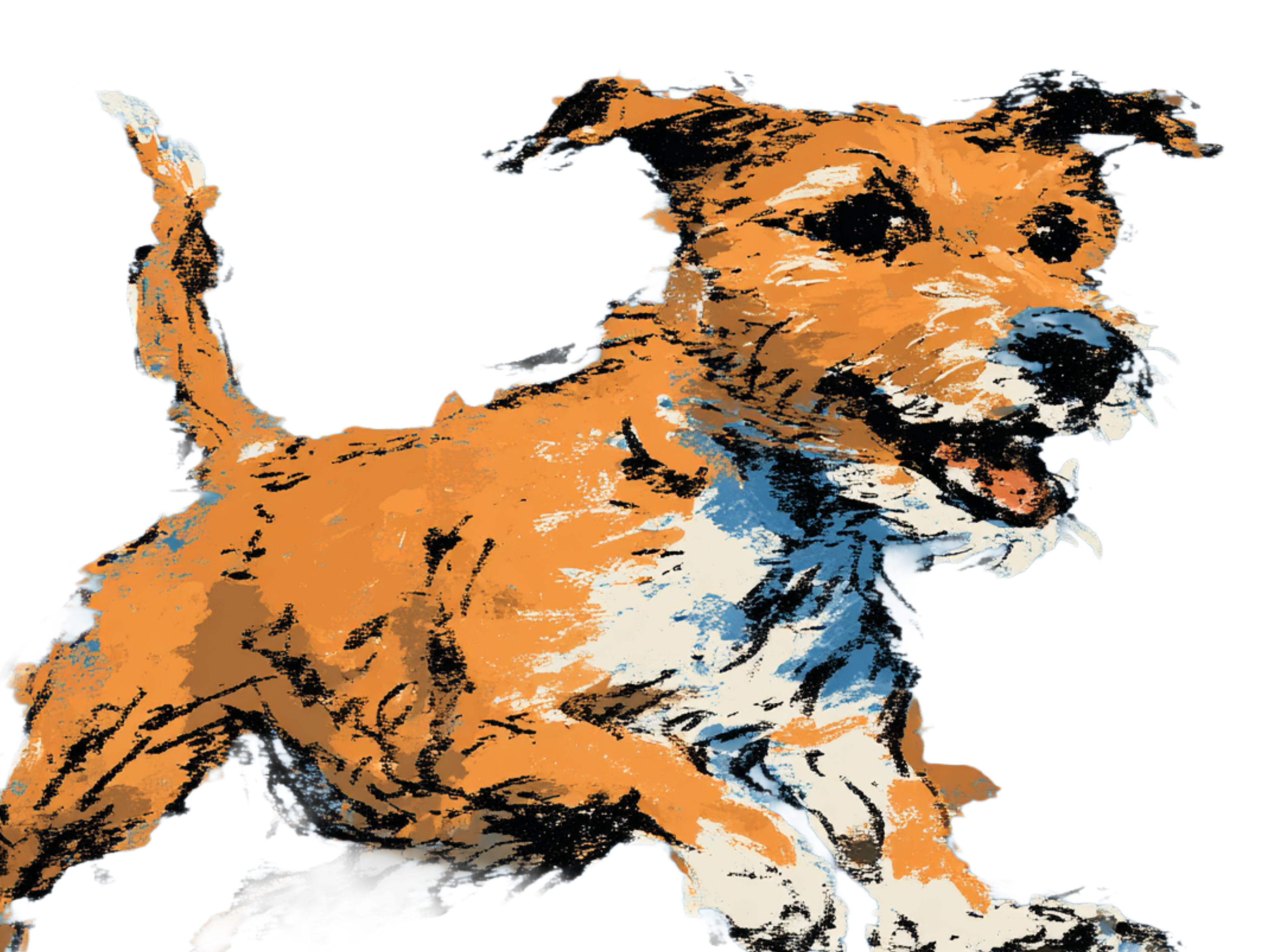
Flyball is one of the most exhilarating dog sports you will ever witness. Two teams of four dogs race side by side down parallel lanes — each clearing four hurdles, triggering a spring-loaded box to release a tennis ball, catching it, and racing back over the hurdles to the start line. The moment the returning dog crosses the line, the next dog launches. The atmosphere at tournaments is electric, the dogs are explosive, and once you have seen it live it is very hard not to want to get involved. This guide covers everything a UK beginner needs to know to get started safely.
Key Benefits
- Intense cardiovascular workout for your dog
- Builds incredible team bonds — human and canine
- Suitable for all breeds and sizes
- Develops speed, agility, and focus
- Vibrant social community for handlers
What Is Flyball and Where Did It Come From?
Flyball is a relay sport. Two teams of four dogs race down parallel 51-foot lanes, each dog clearing four hurdles, triggering the flyball box to release a tennis ball, catching it, and racing back. The first team to complete four clean runs wins the heat. It sounds simple, but in practice it demands precision, speed, teamwork between dog and handler, and a level of noise that makes most other dog sports seem rather sedate.
The sport originated in California in the late 1960s and early 1970s, developed by Herbert Wagner, who demonstrated it on the Tonight Show with Johnny Carson in 1974. It spread rapidly across North America before arriving in the UK, where it was demonstrated at Crufts in 1990. The British Flyball Association (BFA) was founded in 1994 and remains the governing body for the sport today, with hundreds of registered clubs across the country.
What makes flyball unusual among dog sports is its genuinely team-based nature. You are not just training your own dog — you are part of a squad. Your dog's speed matters, but so does the timing of the changeover, the consistency of every dog on the team, and the collective effort of handlers, box loaders and support crew. It is a sport that builds friendships as readily as it builds fitness.
Is Flyball Right for Your Dog?
One of the most appealing things about flyball is how genuinely inclusive it is. There is no breed requirement, no size requirement, and no pedigree requirement. Border Collies dominate at the highest levels because of their extraordinary drive and speed, but Whippets, Staffordshire Bull Terriers, Cocker Spaniels, Labradors, Jack Russell Terriers, and a huge variety of crossbreeds all compete regularly and successfully.
Crucially, small dogs are an asset, not a liability. Jump height is set at 10cm below the shoulder height of the smallest dog on the team, so a Jack Russell, Miniature Poodle or Papillon brings the jump height down for the whole team, giving every dog a faster, easier run. Small, fast dogs are actively sought after by competitive teams.
To compete in BFA-sanctioned events, dogs must be at least 18 months old. This is not arbitrary — flyball involves repeated jumping, turning and sprinting, and a dog whose skeletal development is not yet complete is at real risk of injury. Dogs with significant joint problems, cardiac conditions or respiratory difficulties are not well suited to the sport, and flat-faced (brachycephalic) breeds should be assessed by a vet first. Above all, flyball rewards enthusiasm — a dog that loves to run, retrieve and work with its handler will thrive.
The Course, the Rules and the Box
The flyball course is 51 feet (about 15.5 metres) long. Four hurdles are spaced evenly along it, with the first hurdle 6 feet from the start line, the remaining hurdles at 10-foot intervals, and the last hurdle 15 feet from the box. Jump heights range from a minimum of 20cm to a maximum of 40cm, always set at 10cm below the shortest dog's shoulder height.
Timing is everything. The changeover — the moment the returning dog crosses the start line and the next dog is released — is where races are won and lost. A perfect pass is one where the outgoing dog's nose crosses the line at the same moment the returning dog's does. Electronic timing systems measure runs to the hundredth of a second. Errors that trigger a rerun include missing a hurdle, dropping the ball before the finish line, an early pass, or a handler crossing the start line.
The flyball box is the centrepiece of the sport. It contains a spring-loaded trigger plate; when the dog hits it with sufficient force, a tennis ball is ejected forward to be caught. The box turn — the technique with which the dog hits the box and pushes off — is the most important and carefully taught skill in flyball. The ideal "swimmer's turn" has the dog approach at an angle, hit the plate with all four paws, and push off cleanly. Done well it looks effortless; done badly it puts enormous stress on joints and spine, which is why box work should never be attempted at home without qualified instruction.
Training Your Dog: The Foundation Steps
Flyball training is a gradual process, and the best clubs take you through it step by step. The first thing to develop is ball drive — the dog's desire to chase, catch and retrieve. Not all dogs have this naturally, but it can be built through play and positive reinforcement. Most trainers also use a tug toy as a reward, because a dog that tugs enthusiastically is a dog that is motivated to return to its handler at speed.
Recalls come next. A flyball dog needs to return to its handler as fast as it possibly can, every single time, regardless of the chaos around it. This is trained through repetition, high-value rewards, and making the return the most exciting thing in the dog's world. Once recalls are solid, hurdle work begins with a single hurdle, then two, then the full set of four.
Only when the dog is comfortable with the full run of hurdles is the box introduced, always under the supervision of an experienced coach. Box training begins with the dog simply touching the box face with its paws, and the swimmer's turn is shaped over many sessions before the ball is even added. Throughout, keep sessions short — five to ten minutes of focused training is plenty. Fatigue leads to sloppy technique, and sloppy technique leads to injury. Finish on a success and keep it fun.
Kit, Health and Safety
One of the genuinely good things about flyball for beginners is that you do not need much to start. The club provides the expensive equipment — the jumps, the box, the lane matting and the timing system. What you need is a well-fitted Y-shaped harness or flat collar, a tug toy your dog finds genuinely exciting, a supply of tennis balls, high-value treats, and water with a portable bowl. A crate or settle mat helps keep your dog calm between runs. What you should not buy yet is a flyball box of your own — home box work without supervision creates problems that can take months to fix.
Flyball is physically demanding, so warm-up and cool-down matter enormously. A warm-up of at least five minutes of walking, easy trotting and light play should precede any jumping, and the cool-down should be equally unhurried. Surface matters too — sports-hall flooring, short turf and well-maintained grass are fine, but slippery floors, hard concrete and uneven ground increase injury risk, particularly during the box turn.
Watch for signs your dog is struggling: limping or stiffness after training, reluctance to turn at the box, knocking hurdles it would normally clear, or a flat, disengaged demeanour. None of these should be ignored. If your dog is a giant breed, be especially mindful of gastric torsion (bloat) — do not feed within an hour of training. A relationship with a canine physiotherapist is well worth developing if you become serious about the sport.
Competitions, Titles and Community
BFA tournaments are organised into divisions based on team speed, which means racing is always competitive regardless of your team's level — slower teams race slower teams, faster teams race faster teams. Starter and Intermediate events are designed specifically for newer teams: at Starter level a box loader can manually release the ball, and lane netting and box wings can guide dogs. These lower-pressure events are the ideal entry point.
The BFA operates a Milestone Awards system through which individual dogs accumulate points based on clean runs completed within their division's time threshold. Titles run from Flyball Dog (20 points) through Flyball Dog Champion (500 points) all the way to Flyball Grand Champion (50,000 points). Watching a dog accumulate points over a career is one of the quiet pleasures of the sport.
The flyball community in the UK is, by general consensus, one of the most welcoming in dog sport. Beginners are actively encouraged, because every experienced team was once a group of beginners. The best way to find a club is through the BFA website's club finder at flyball.org.uk — most clubs will welcome you to watch a session before committing. Expect noise: flyball training is not a quiet pursuit, and if your dog is noise-sensitive it is worth mentioning to the coach in advance.
Quick Facts
Fitness Level
High intensity sprints
Best Season
Year-round (indoor & outdoor)
Min. Age
18 months to compete
Governing Body
British Flyball Association (BFA)
Frequently Asked Questions
Q.What breeds can do flyball?
Any breed and any size. Border Collies dominate at elite level, but Jack Russells, Staffies, Spaniels, Labradors and crossbreeds all compete. Small dogs are especially valued because they lower the jump height for the whole team.
Q.How old does my dog need to be to start flyball?
Dogs must be at least 18 months old to compete in BFA-sanctioned events, because their growth plates need to be fully developed before the repeated jumping and turning. Gentle, low-impact foundation training can begin earlier.
Q.Do I need to buy expensive equipment?
No. The club provides the box, hurdles, matting and timing system. You only need a well-fitted harness or collar, a tug toy, tennis balls, treats, and water. Do not buy your own box until you are experienced and your coach advises it.
Q.Why can't I teach the box turn at home?
The swimmer's turn must be taught precisely to protect your dog's joints and spine. A poorly taught box turn is one of the leading causes of injury in flyball, and bad habits formed early are very difficult to undo. Always learn box work with a qualified coach.
Q.How do I find a flyball club near me?
Use the club finder on the British Flyball Association website at flyball.org.uk. Clubs are listed by region and most will happily let you watch a training session before you commit.
Get the Complete Guide
Free PDF with everything you need to get started
We respect your privacy. Unsubscribe anytime.